
Rapturous | Foolish |Impractical | Untethered | Eternal | Voyager |
Susan Plunket
Susan Plunket is a psychologist and writer of spiritual science fiction. She received her doctorate at The New School for Social Research in 1989 and has been in private practice in New York City for the last 32 years.
She is a member of the Editorial Advisory Board of Quadrant, The Journal of the C. G. Jung Foundation of New York. Her favorite part of her work is interpreting dreams. She’s currently working on book three of her trilogy in which she explores the worlds of the Fourth and Fifth Dimensions. She lives with her family in Greenwich Village unfortunately still in the Third Dimension.
susanplunket.com

My 10 Best
(In no particular order)
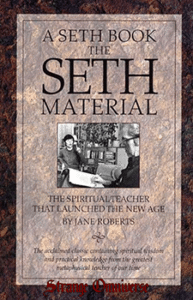
The Seth Material
I first read Seth Speaks nearly fifty years ago as a twenty-five-year-old and it shook me to my core. The idea that we are creating our reality every day by projecting our thoughts and emotions outward into physical form blew me open, affecting both my waking and my dream lives. Discovering that the self that I thought I knew as me is but a fragment of who I actually am, my Entity, my Soul, frightened my younger self. That each of us is living many other lives simultaneously, not spread out over time in the typical view of reincarnation, but all at once as there is only now, capsized my idea of the world. My current self is comfortable with these ideas and the fact that we exist in the midst of many other systems of reality which we don’t generally perceive because we’re so focused on external reality. Reading Seth Speaks started me on a journey into my own mind and initiated my first real reckoning with who I am, who we all are, and what we are capable of creating.
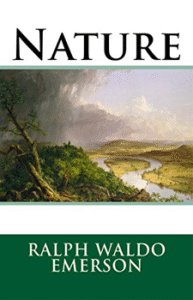
Nature
Valuing intuition over reason is not the common way, but it was the choice of the Transcendentalists, Emerson and Thoreau foremost among them. Thanks to yet another college course taught by an elderly professor named Dr. Byrd, I fell in love with Emerson and the transcendental idea of feeling the Divine through nature. I remember sitting on my bed writing a paper by hand, this was well before students had laptops or even large computers. The paper was on Emerson’s “Nature.” I was burning up with the desire to express my excitement and joy at the ideas I encountered there. The words spilled out of me onto the paper balanced on my knee almost faster than I could write. I knew I understood what he intended and it rang true to me. It was as if, though long dead, Emerson’s mind was speaking directly to mine. In years to come I would have this experience repeatedly when reading Carl Jung. And when Dr. Byrd returned my paper to me several weeks later he had only one comment written on it. “I regret that I have but a hundred points at my disposal with which to recognize the merits of your paper.” Usually I didn’t receive such comments. Being an intuitive I was more often criticized by my professors for making leaps rather than following logically on.
Memories, Dreams, Reflections
In the last years of his life Jung wrote an autobiography of sorts. And when you read it you feel he’s speaking to you, to your heart and mind, at least that’s how I feel. I read it long before I went to graduate school to become a Jungian psychologist but I suppose it is one of the reasons I chose to get a Ph.D. in psychology after having been a high school English teacher for two years, helping to found a free university called Apple Skills Exchange in New York City, selling cars in Berkeley, CA. for two months, and waitressing at Windows on the World for a summer. Jung opened my eyes to the idea of the collective unconscious which is the place or state where we meet our greater Self in its many aspects. Because of this book I began my first Jungian analysis and worked harder to catch my dreams. For me, dreams are akin to the gift of fire. After 33 years in private practice working with dreams my respect for the gift of a dream has only deepened, as has my love for Jung.
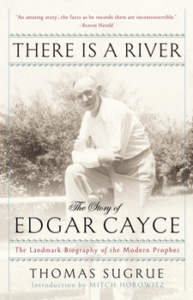
There is a River - Edgar Cayce
Sugrue’s biography of Edgar Casey is heartwarming and heartbreaking. I’ve read it at least three times over the past two decades. It’s a firsthand account by someone who knew him of Casey’s struggle to use his gifts to be of service to others. He had a well-developed access to his inner senses, senses which we can each develop if we learn to shift our focus from our very compelling external reality inward. The book contains a clear description of how he journeyed to get information to help others. Casey didn’t use his gifts for his own gain, and often he and his family suffered hunger and cold. He was sometimes taken advantage of and yet he persevered in his desire to serve others. I now understand years after first reading about his life that Casey knew the path to enlightenment was through service.
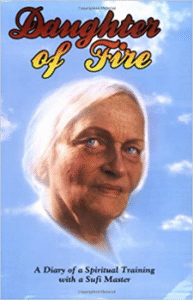
Daughter of Fire
Irina Tweedie (1907-1999) was a woman on a spiritual quest, which was somewhat unusual for a woman in the 1950s and 60s. Not only did she begin her spiritual quest in her 50’s but she found a guru in India, a Sufi Master, and moved there. I don’t know how this book first came into my hands but I’ve read it again and again over the past 30 years, not just because it’s a rare look into a Sufi Master–disciple relationship and completely engrossing in its raw honesty, but also because as a record of spiritual transformation it is untouchable. It is a diary of Tweedie’s five-year sojourn with Sufi Master Bhai Sahib, during which time she underwent the agony of ego dissolution and surrendered to all-consuming love. She learned how to live with God as a living reality, to relax within the endlessness of love, to rest in God, body and mind, even while doing housework or shopping, to talk to Him all the time. The discipline was severe but her desire was strong.
The Florence Scovel Shinn Reader
It was a patient who first recommended this book to me. We had been talking of how humans use their thoughts and emotions to create their reality, even to manifest things physically. And she asked me if I’d ever read a book which she believed was written in the 1930s called The Game of Life and How to Play It by a woman named Florence Shinn. I hadn’t, but promptly ordered it as part of the Florence Scovel Shinn Reader. Shinn’s philosophy is simple. Focus on what you want to create in your life. You are the creator of your reality because all beings are God in manifestation. With a mixture of fearless faith, non–resistance and love ,everything is possible. This is a lot like what Seth teaches. For years, I have kept the affirmation cards that came with Shinn’s book on my desk to remind me to be mindful of what I was thinking because it would manifest.
Heaven and Hell
I’ve had this book so long that the price on it is $5.95 and the cover has bite marks from a beloved cat long crossed over. Written more than two centuries ago it addresses the same questions we wonder about now. Swedenborg’s short answer is “Happiness is within only.” I wrote this on an index card two decades ago and I still have that index card. He writes about how modern man – for him modern man was a man of the 1700’s – had lost touch with his inner senses and focused too much on outer reality. He urges humans to use their inner spiritual sight to see the Divine and the angelic realm as he has done. There is much correspondence among all these authors I have mentioned. Seth, Jung, Emerson, Shinn, all urge us to develop our inner senses.
The Bhagavad Gita
In college a visiting professor came from India. He was a beautiful and gentle Soul and it was he who first introduced my seventeen-year-old self to The Upanishads. From the start, the part which spoke to me most was The Bhagavad Gita. Mitchell calls it “a love song to God,” and “a love song to both the darkness and the light.” The conversation between Arjuna and Krishna on the battlefield contains some of the most beautiful poetry and ideas I’ve ever read about the Divine. I am the taste in water The light in the moon and the sun The sacred syllable Om In the Vedas, the sound in air I am the fragrance in the earth, The manliness in men, the brilliance In fire, the life in the living, And the abstinence in ascetics. I am the primal seed within all beings, Arjuna: The wisdom of those who know, the splendor of the high and mighty. Thinking of God as “the primal seed within all beings” offered my teenage self a way to understand that we are each Divine.
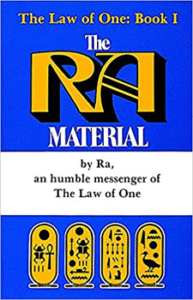
The RA Material
This series of seven slim volumes channeled in the early 1980’s through Carla Rueckert lifted me up and carried me to a new space of understanding and joy and hope about what it means to be human. It is also the work that most deeply affected my own writing. Ra’s ideas underpin my spiritual science fiction trilogy. Ra is a Sixth-Dimensional social memory complex, a group being who dwells outside of time. Ra teaches the Law of One, which states that all beings are part of the Oneness, The Divine. Each of us can choose to recognize that we are part of the Divine and therefore choose service to all. Or we can choose service only to self and believe we are separate. I wish I knew how these books first came into my hands. It was back around 2016 shortly after an Australian Aboriginal shaman I work with told me that I was to write a trilogy which would be largely downloaded to me during my dream time. The first two books of the trilogy are out and the Law of One figures prominently in them and in the way I approach my daily life. I am grateful to Ra and Carla and her team.
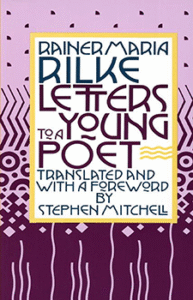
Rainer Maria Rilke Letters to a Young Poet
Because I can’t choose a tenth book from those below, I will just list them. I love and re-read each of them often: Letters to a Young Poet – Rilke The Essential Rumi – Coleman barks translation War and Peace – Tolstoy The Collected Works – C.G. Jung Cosmos – Carl Sagan A Writer’s Diary – Virginia Woolf