

Author | Musician | Documentary producer | Astrologer | Cat butler |
Ronnie Pontiac
RONNIE PONTIAC worked as Manly P. Hall’s research assistant, screener, and designated substitute lecturer for seven years. He is author and co-author of a trilogy about metaphysical countercultures in Western Esotericism published by Inner Traditions: American Metaphysical Religion: Esoteric and Mystical Traditions of the New World (2023) and The Magic of the Orphic Hymns: A Translation for the Modern Mystic (2023), co-authored with Tamra Lucid. A third volume about the political and social context of Rosicrucian origins will be published in 2024.
Ronnie has produced award winning documentaries including Viva Cuba Libre: Rap is War (2013). He has written for Invisible College Magazine, Newtopia, Metapsychosis, Occult of Personality, and the original Reality Sandwich. He lives in Los Angeles with Tamra Lucid, author of Making the Ordinary Extraordinary: My Seven Years in Occult Los Angeles with Manly Palmer Hall (2021), a memoir published by Inner Traditions. They play with the underground indie band Lucid Nation.
https://linktr.ee/ronniepontiac
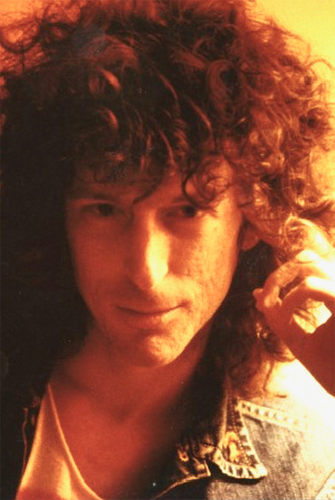
My 10 Best
(In no particular order)
Tap a book cover to read his thoughts about the book.
The Secret Teachings of all Ages
Better known as The Secret Teachings of All Ages, this book inspired the journey that led me to meet and work with its author. I remember the feeling I had after reading each chapter in the cramped bedroom of an apartment just off the Sunset Strip. I felt as if the walls of my habitual consciousness dissolved into sky. The courage of the many writers and artists curated in this masterpiece, who left their creations to future generations, often at risk of their lives, changed my entire view of life, and awakened in me a thirst for knowledge. I have often heard similar stories from others who began their path in the reassuring and trustworthy hands of Manly Palmer Hall. This book is dedicated to “the Rational Soul of the World.” What a revolution in a small phrase. As I often heard him tell visitors who asked him to be their teacher: “Nature is your teacher. The world is your teacher.”

The I Ching or Book of Changes
Known as “the Crisis Book,” this oracle can be a lifelong friend. I recommend reading any and all translations of the Yi Jing, as we call it more correctly these days, but Wilhelm and Baynes have always been a good starting point. This book can simply be consulted for advice about the challenges of life. For readers who want to know more about history and context there is useful information. But keep in mind that Wilhelm was far from a great Chinese scholar. Comparing different translations we can get glimpses of deeper correspondences English can’t quite capture. Most of my life has been an experiment with the Sage, as this oracle calls itself. It can get salty, and graphic, so be prepared to be called an ignoramus, if warranted. It will not hesitate to say: “I told you so.” But it can be genuinely kind. It has gotten me out of more messes than I can remember. It will sometimes send me into a mess, but only so I can avoid a bigger mess down the road. My lifelong conversation with this oracle has never failed to amaze me. In so few words it can acknowledge with breathtaking accuracy the question asked, and provide answers that over time teach us how to recognize and respond in a more harmonious way to the rhythms of life.
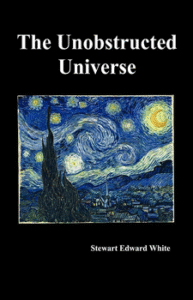
The Unobstructed Universe
Stewart Edward White is all but forgotten now, but he was famous in the 1930s and early 1940s when his books about life after death became bestsellers. Undeniably categorized as a medium, but quite distinct from the run of the mill variety, his wife Betty, did not talk to dead relatives or diagnose illnesses. Together they explored the frontier that is the afterlife with the same enthusiasm with which they explored Africa and Alaska. They gave descriptions, concepts, the nuts and bolts of how things work, and what connections are possible between there and here, and between here and there. A kind of handbook of life and afterlife. These spirits referred to themselves as the Invisibles. Our world is obstructed, they taught, but in our true forms we are unobstructed. There are not two separate worlds, just a difference in frequency. Our bodies force us to inhabit low frequency obstructed experiences for the purpose of learning. The evidence presented in “the Betty books,” as they were known, was so convincing that when Betty died and communicated from the other side, Who’s Who refused to print a death date for her. Carl Jung was impressed, too. He wrote in a letter to a friend that he believed Betty communicating from the unobstructed was not only an archetype but an actual spirit.

The Dark Red Amulet
This book reveals a powerful practice of the Vajrakilaya tradition of Tibetan Buddhism. The chant it features can be heard on YouTube sung by monks. In Christianity we have the idea of demons at war with the divine, and creation, until the end of time. In the Vajrakilaya practice demons are summoned by loud clashing symbols and discordant horns that attract their attention. Then they are caught in the chant that tells them they are helpless to resist. The moment has come when enlightenment, which is the destiny of all beings including demons, must liberate them. This can be depicted as a wrathful deity slaughtering the dumbfounded demons. But this dynamic also represents the individual practitioner calling on his or her internal demons, complexes, and shadows to be liberated, that is integrated into the well being of a life well lived. This is an advanced practice and should not be attempted by beginners without the guidance of a teacher. But reading about the chant, and the philosophy behind it, can be an enlightening experience in and of itself.
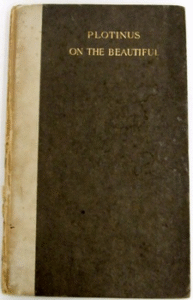
Plotinus on the Beautiful
It can be read in an afternoon. Pick a lovely place, a time when you won’t be interrupted, and savor the words that create a ladder of appreciation beginning with the mundane and rising to the sublime. Emerson used to joke that reading the Neoplatonist Proclus regularly would make a man more handsome. Fellow Neoplatonist Plotinus spoke this poetic prose meditation that lifts us to the good, the true and the beautiful.

The Flower Ornament Scripture
I have recommended this scripture to people facing the most difficult moments of life. Vast beauty and mercy are described in this book. Countless universes, where buddhas are beaming enlightenment to all beings in detailed descriptions of assemblies of cosmic liberators. A universe of jewels reflecting all other jewels. But this book is more than a glimpse at a gorgeous infinity. Gems of wisdom about the nature of life, and about the practice of attaining and maintaining awakened consciousness add extra spiritual nutrition to this feast that gives the reader the feeling of having infinite assistance, and a brilliant future, even in those moments when human beings feel most vulnerable and alone.
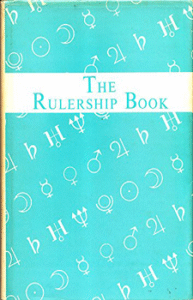
The Rulership Book
Speaking of Plotinus, he provides what I consider the best description of how astrology works: “The stars are like letters that inscribe themselves at every moment in the sky. Everything in the world is full of signs. All events are coordinated. All things depend on each other. Everything breathes together.” When Manly Hall convinced me to study astrology, all the astrologers working at his Philosophical Research Society suggested books I should read, and some generously gave me rare ones. This was one of them, not rare but it is very useful. It consists of long lists of the details of life and what planets, signs and houses they represent. Simply reading the lists and pondering why seemingly unrelated objects and subjects should be considered under the planet Saturn, for example, is a deep meditation you don’t have to be an astrologer to enjoy. The book can become a kind of symphony of correspondences, revealing hidden harmony and coherence. Using this book to look up the events of life as they happen is an education that can help any astrologer improve their practice of this mysterious art.
The Hymns of Orpheus
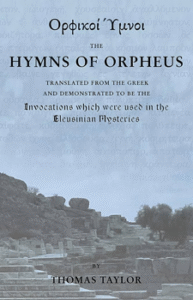
Marsilio Ficino, a Catholic priest with an appetite for the esoteric, whom many have referred to as the “father of the Renaissance” declared that no magic is more powerful than the Hymns of Orpheus. He wrote: “I learned from Orpheus that love existed, and that it held the keys to the whole world, the whole power of magic consists in love.” He often sang the hymns, to his friends accompanying himself on a lute with Orpheus painted on it. The astonishing influence of the Orpheus myth and related literature on the history of western countercultures and esotericism is covered in a book I co-authored called The Magic of the Orphic Hymns (2023), which includes a new translation. But this, the first translation of the hymns into English, inspired Keats and Shelley, William Blake, Ralph Waldo Emerson, Madame Blavatsky, and many more including Manly Hall. The last work I did with him was helping out on the publication of a reprint of this book by his Philosophical Research Society Press. Taylor is not an easy read. For those unable or unwilling to explore the density of his prose, gems can be found simply by browsing the pages and looking for phrases that stand out. The copious notes are complicated but filled with fascinating history and interpretations.

God is Red
First published in the 1970s this is a controversial book that criticizes Christian culture with a justifiable anger born from generations of abuse suffered by indigenous people. A history of the politics of conquest and resistance, it reveals the profound differences between Judeo-Christian notions about nature and the soul and those of the tribes, each unique, yet all sharing a great respect for nature, dreams and the ancestors. Deloria shows us how cultures that live in harmony with nature are healthier and more sustainable than those that merely seek to exploit for profit. Religious and scientific authorities dismissed the belief that animals, plants and even rocks are beings deserving respect, that they have souls, as “the pathetic fallacy.” But most readers will find themselves longing for the kind of connection that only mutual respect can provide.
The God of Ecstasy
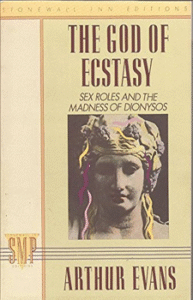
Evans would later write the obscure but epic Critique of Patriarchal Reason, dismantling the myth that reason trumps all other human attributes. This, his first book, is a rip-roaring history of the religion of Dionysus with speculation about possible origins in India, and about the possible influence of Dionysus on Christianity, for example, the sacrament of wine. Evans studies the witch persecutions and finds that many of the persecuted were practicing the remnants of pagan religious traditions, and that sexual preference and gender made some more vulnerable to accusations than others. As well as being a scholar, Evans was a pioneer of the gay rights movement. The book ends with a clear and beautiful translation of The Bakkhai of Euripides. In a sense everything that comes before in this book sets the stage for a more complete understanding of this tragedy’s troubling portrait of human nature. We see how the battle it describes between the rational and irrational, the militaristic and the artistic, the elite and the counterculture, the ego and the shadow, continues to create conflict in contemporary culture and in individual lives. Dionysus was called the liberator and this book will not only give the reader an understanding of why, it inspires the desire for freedom.