

Modern Mystic | Author | Curator | Producer | Photographer | Communications Strategist | Healer | One with Gaia |
Renee Blodgett
Renee Blodgett is the founder of Blue Soul Media, which was born from a career in branding and marketing and her work as a consciousness teacher, facilitator, and curator. She has created a system known as soul alignment strategies which sets people on a life trajectory filled with purpose, alignment, connection, and passion. She also leads mentorship programs, Study with Spirit® workshops, courses and retreats at Blue Soul Earth®.
Renee is also the producer of Blue Soul Summit®, an online platform that brings together visionaries across industries, all making a shift in consciousness. For over two decades as founder of Magic Sauce Media, she produced award-winning PR and marketing campaigns for Fortune 500-level and start-ups. As spokesperson for her clients, she has appeared on and in Good Morning America, NPR, BBC, Wall Street Journal, CNN, CBS News and countless others.
As an author and editor, Renee has penned over 5,000 articles in off and online magazines, Huffington Post and in her award-winning online travel magazine We Blog the World, which has over a half million reach globally. She has partnered with leading event producers, such as New York Times Travel Show, the Adventure Travel Show, the Healing Summit, Wisdom 2.0, SAND, New Living Expo, IONS (Institute of Noetic Science), Healing Hotels of the World and others.
Keen on making a positive impact on the world through social good, Renee has been co-curator and producer of TEDxBerkeley, one of the largest and most prestigious TEDx events in the U.S. for over a decade. She also spearheaded content for TEDxUNPlaza, the only TEDx event held at the United Nations. Learn more about her work at
www.bluesoulmedia.com
www.bluesoulearth.com
www.weblogtheworld.com

My 10 Best
(In no particular order)
Eye of the Heart
Regardless of your belief system, Cynthia Bourgeault’s deeper probing into the imaginal realm allows space for us to re-define our understanding of what some refer to as dimensions or where some people “go” when in an altered state of consciousness. What I love about all of her books is the raw and bold at times sharing of her own journey, allowing us to enter into that vulnerability with her. We are invited to meander down a mystical path and along the way, her background as an Episcopal priest and theologian is woven in, which gives credibility to her work. In this way, she challenges Christianity as we’ve come to learn it. She also so eloquently brings in other traditions as a way to explain these imaginal realms, including eastern schools of thought, perennial wisdom and archetypes we can learn from. The teachings include the wisdom of Teilhard de Chardin and his so-called “theological virtues,” which are “streams of radial energy changing outcomes in the physical world.” Of course, this leads us to manifestation and the lushness of what its basic principles teach us again and again. Don’t think of these realms as a “place” she reminds us. From Identity, God, Love and Alchemy to the Universe, Psyches our Aliveness and Purpose, we go on a quest with her. It feels as if there’s not a topic we don’t cover along the way, from science and physics to ancient wisdom and spiritual mysticism. What I most marvel at with Cynthia’s work is her exquisite use of language as she does the dance of teaching and reflecting across cultures and she does so with vigor. She goes deep and if you’re ready to deep with her, you’re left with awe-inspiring revelations on the other side.

The Wizard of Us
I was first introduced to Jean’s work not through her earlier books, talks or accolades but at the SAND Conference, which stands for Science and Non-Duality for those not familiar with it. I attended the event for about a decade, always held in a mansion in San Jose California and each year, Jean would speak. I’d sit on the floor in front of all the seats, like a child waiting for one of the best storytellers to share her words of wisdom. It wasn’t until years later that I made my way to her books and interviewed her for our own video series, Blue Soul Summit. Like she did at SAND and in many of her books, I was taken into her marvelous prose again and again. She’d look up into the air, pondering how she was going to either answer a question or explain something we were chatting about, because her responses are never random. That conversation happened shortly after I finished four of her books including The Wizard of Us. Why this one popped shouldn’t be a surprise for anyone over the age of 40. The Wizard of Oz was an integral part of the lives of children born in the 1950’s through the 1970’s and beyond. This book goes down the yellow brick road with Dorothy, and as she interacts with all the characters along the way, we see the archetypes of each of them in all of us. Jean is known for her work with archetypes and we can now see them emerge through a favorite childhood story and movie, ones which we can all tap into and bring to light in our own lives, including the shadows of who we believe ourselves to be. Have no fear, she says. Dive right into all of it. Remember, we are the all and yet we are the one. Transformative lessons are conveyed along the way, but done with such vivid detail, color and texture, you feel as if you are on that yellow brick road with Dorothy and her rich imagination of Oz, both seen and unseen. The message of oneness is divinely inserted in ways that the read feels, experiences and innately knows. It’s a beautiful ride.

What is Real?
You can’t go on a deep and comprehensive spiritual quest without exploring the world of quantum physics. I came across his book after reading about the series of events that took place in the 1920’s, weaving in the profound unveilings of Niels Bohr, Wolfgang Pauli, Werner Heisenberg, Albert Einstein, John Bell, David Bohm, Hugh Everett, Thomas Kuhn, Max Planck, John Wheeler and others. I couldn’t get enough of their stories and how their discoveries affected each other, sometimes in controversial ways, other times complimentary. I was dumbfounded that I hadn’t taken interest in these historical events in college – why hadn’t they made their way into my awareness? As a creative, I was always more mesmerized by philosophy, art and music but what was revealed to me was simply art in a different form. I began to see that spirituality and science were always cut from the same mold, simply using different language to get there. Language is key to opening us up to understanding, where the heart is what keeps us there, allowing the lotus flower of who we all are, to beautiful unravel as it may. Because physics was so far from my wheelhouse, it took me years to get my head around the language and grasp it. Why did it matter and how did it affect me in the here and now? Becker’s book makes it tangible. It makes it comprehensible. It makes it interesting. And, it makes it digestible. Make no mistake: it’s not a dumbed down version of quantum physics but if you have an interest and a basic foundation of some of the principles, you’ll be brought into yesteryear and learn about this time in history. At times, you literally feel as if you’re in a salon with some of these characters, having coffee with them. Allow your imagination to go there. Along the way, you’re brought into non-local realities, questioning the definition of reality itself.
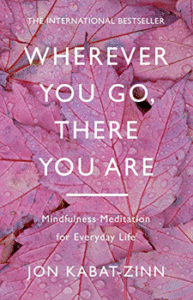
Wherever You Go There You Are
Although I’ve read hundreds of spiritual books by teachers I respect and adore since the first time I read this classic bestseller, I have found myself returning to it over the years, pulling out wisdom and advice at pivotal times in my life. Life is forever changing so we’re always in transition. There’s a simplicity to the writing and to the wisdom, reminding us that we need not be perfect, but be as we are. He also gives examples of things to try as part of your regular spiritual practice, as a pathway to mindfulness as a way to be. Every day. In every moment. This is the beauty of his work. It need not be complicated. When we grow, we change (if we allow ourselves to) and then expansion leads to a wider view of the world. Through that lens, there’s less suffering because we now understand it as a choice, not something that happens “to us.” It’s so simple, that sometimes it’s hard, isn’t it? He uses quotes to bring us back to that simplicity. “My religion is kindness,” said the Dalai Lama. Indeed. Wherever we go, there we are, so there’s no escaping our shadows. There’s no escaping doing the work. There’s no escaping our beliefs. Through awareness however, we can move through those beliefs to something greater than ourselves. Our true self. He writes: “Awareness is more like a vessel which can hold and contain our thinking, helping us to see and know our thoughts as thoughts rather than getting caught up in them as reality.” An ancient teaching to be sure, but one we need to return to again and again.

When Things Fall Apart
Ahhh yes, one of my favorite Buddhist masters. I have two versions of this book, a paperback version and a hardback copy, which is very old. I must have read the latter version a dozen of times, the cover torn and notes are scattered throughout. I’ve read all of Pema’s books but this one holds a special place for me. Perhaps it’s because I first read it after my divorce. Perhaps it’s because I read it again after another tragedy in my life, or now I can easily say, a perceived tragedy. What’s not to love about Pema’s writing? It’s raw at times, but that’s exactly where we need to go – those raw parts of ourselves that feel the wound when outside forces hit us in this physical realm we call life. It was revolutionary when I first read “ you must go through the muck to get to the other side, not dart around it,” for running from something that is uncomfortable is often our go-to choice. It’s easier isn’t it, or at least it appears that it is so. When we go through a major hiccup along our path, a simple thought can quickly escalate and into the worst possible scenario. Suddenly, we are locked in fear and from that place, it’s hard to emerge with hope and love. Certainty feels so far away, doesn’t it? But as life marches on, we come to realize how much our earlier conditioning colors our perception of reality. We begin to see that it’s not our reality at all, but someone else’s belief systems we’ve simply taken on as our own, often without realizing we have. Those beliefs begin to dictate how we live our life, where we show up and with whom. Simple awareness allows us to break through outdated paradigms, conditioning and patterns of behavior, the only ones we have come to know. She writes: “the painful thing is that when we buy into disapproval, we are practicing disapproval.” Later she writes, “Instead of struggling against the force of confusion, we could meet it and relax. When we do that, we gradually discover that clarity is always there.” Hear hear.
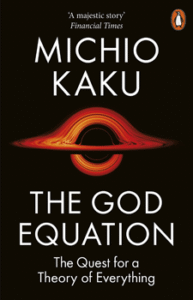
The God Equation
In this book which is subtitled, “The Quest for a Theory of Everything,” we explore theoretical physics. If you’re new to physics, you may not be aware of the countless conflicts that exist between theories and some of these conflicts have contributed to the divide between science and spirituality. A big part of my work is about creating a healthy bridge between science and spirituality as more and more are discovered on both sides, softening the triggers that have existed for years. What I love about Kaku’s work is that he includes topics that are perceived impossibilities by some, such as time travel, multiple universes and multidimensional realities. He uses an interesting example of time travel, such as the ability to go back in time and save Abraham Lincoln from being assassinated. If you end up stopping the shooting from happening, then you have saved Lincoln, but not in your timeline, but in a parallel one. He explains, “the Abraham Lincoln in your universe did die, and nothing will change that. But the universe has split into two universes, and you have saved President Lincoln in a parallel universe.” In other words, “new universes are being born out of our universe all the time.” Along the way, we explore dark energy and matter and why better understanding both, matter. Like the work of Dr. Ervin Laszlo, Joseph Selbie, Deepak Chopra and others, we get a beautiful (and I’d argue elegant) bridge between the world of God, Oneness or Universal Consciousness on one side and science and quantum realities on the other. Finally, they come together again.
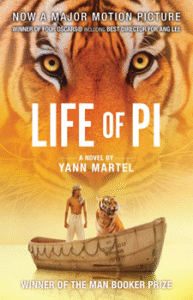
Life of PI
Some of you may have seen the movie and when I finally did, it simply didn’t feel anything like the book to me. That’s not to say that there are not overlapping scenes or dialogues, but the brilliance of the novel is in the intricate details and what goes on in the head of Pi Patel, the main character, an Indian boy who is the son of a zookeeper. He is a boy who loves and practices Hinduism, his native religion, but also Islam and Christianity. There’s a scene that brought me back to my own childhood, where adults are arguing over what religion he “should” be practicing. Meanwhile, he embraces them all, as I felt when my relatives did the same between Methodist, Catholicism, Lutheran, Episcopalian, Baptist and Judaism. As astonishing as it may sound, I dabbled in all of them early on in my life and although I was baptized in three out of the six, I ended up living on a kibbutz at age 18. I’ve learned that there are no accidents in our lives, merely synchronicities which arise out of other synchronicities. These are all probabilities that can occur in our life and along the way, we choose a probability that changes the course of our life in each moment of our day, as new thoughts, ideas and decisions arise. The profound experiences I had across these traditions changed the trajectory of my life and how I show up each day, just as it did for Pi. On a journey to North America aboard a Japanese cargo ship, he must fight for his life, as he is faced with survival with a Bengal tiger as his only companion. While it may seem like fantasy, if we see it as symbolic to things which arise in our everyday life, we can learn as much about undoing what we’ve learned as implementing what we have. You can’t help but smile as lesson after lesson is uncovered, for us the readers, to take away with us for our own life path. There’s a little of all of us in Pi. Brilliant, tender and sweet, I loved this book.

Sophie’s World
First of all, I’ll start by saying that I’ve devoured this riveting read three times. Touted as a novel about the history of philosophy, you are brought into the minds of the world’s most favorite philosophers across time. It’s one of those page turners you think about in your dream state as well as your waking state. Like many of the teachings, you find yourself wondering which one is more real. The dialogue throughout most of the book is between a fourteen-year-old girl named Sophie who wants to explore philosophy more than anything else, finding the rest of her academic studies “boring,” or simply not relevant to the “real world.” She embarks upon a wild ride with a philosopher teacher who brings her lesson after lesson through the mail. Yes, the mail. Visualize one of those old-fashioned post boxes at the edge of a walkway to your childhood house and you get the idea. A correspondence course of sorts, which covers everyone from Socrates to Sartre. As someone who studied Philosophy in college and has continued to return to my favorite philosopher’s guiding principles, it was such a delicious experience. Each chapter focuses on the core belief systems of each philosopher, with modern examples to demonstrate their plea. Most people are familiar with the ancient wonders like Aristotle and Plato – “a longing to return to the realm of the soul.” But what about where all the “greats” overlapped on the idea of God, the Universe and our very existence? The definition of reality itself? If you’re intrigued by myth and history, you won’t put it down. If you’ve questioned the line between fantasy, science fiction and spiritual realism, you won’t put it down. I loved going back in time, which so often felt like present, to have coffee with Locke, Hume, Berkeley, Descartes, Hegel, Kant, Darwin and Freud. It’s such a delicious navigation in and out of philosophical thought across the ages as well as into unseen dimensions that perhaps are more real than we think they are. It should be no surprise that it was an international bestseller.
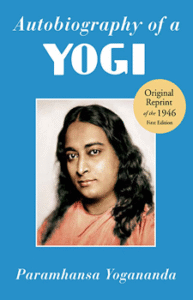
Autobiography of a Yogi
Sure, this title may be on a lot of people’s lists who have gone on a spiritual quest and those who are still committed to one until the day this reality ends and they merge into another one. When someone whose opinion I trust tells me to read something, I typically order it the same day. Then I realized it was around 550 pages long. As someone who has led book groups in London, Johannesburg, Boston, San Francisco and Amsterdam, I’m not afraid of long books but when I’ve got several books going at once (often the case), there’s always a little hesitation at first. “I can’t believe you haven’t read it yet,” said a friend who is what I’d call, a spiritual entrepreneur. “Okay, okay,” I said and I dove it after getting over the page count. Four days later, I had finished it and found myself wanting to revisit certain sections again. What a visionary he was, and during a time when it took a lot more courage than it does today. He set the foundation for many spiritual teachers to follow. If you grew up Christian, you may have heard of the remarkable miracle that Jesus performed in raising Lazarus from the dead. Symbolic, you thought. The kind of thing that gives religion a bad name among materialists, you think. C’mon, really? And yet, as we dive deep into the world of Hindu yogis and mystics in the east and saints in the west, we see that miracles are not as uncommon as we think they are. Although told from a spiritual master’s perspective, we dive deep into the mysteries of the universe itself, allowing us to see the unlimited potentials available to all of us. Although there are so many favorite excerpts and teachings to impart, I love his revelations about truth itself, drawing upon not just his Hindu teachers to get the point across, but Buddha, Lao-tzu, the Rishis and Jesus as well. He writes: “For man, truth is unshakable knowledge of his true nature, his Self as soul.” He then goes on to speak about Jesus who proved that “he knew the truth of his being – his source in God.” It’s the omnipresent Christ Consciousness that exists in all of us. The I am consciousness of who we are. He also talks about the divine purpose of creation as well as the power of vibrations and sound. AUM-ing your way through life isn’t a bad place to start for it is indeed a primordial sound. Here we are in attunement or you could say alignment. Science is woven in too btw, showing the overlapping resonance between the two disciplines. The secrets? Too many to share here, but understanding our essence as light is a wonderful place to rest for a while as you watch the magic unfold.

Bend, Not Break
I first heard Ping Fu speak in Silicon Valley at some advanced technology conference held at Stanford and then later again at a Singularity event I was involved in, mainly marketing it. This time I had a chance to meet her and chat. This led to a dinner followed by me photographing her for a book I was working on at the time on conscious entrepreneurs who turned to love and purpose in their business decisions. She was one of them. It wasn’t until after I photographed her that I actually read her book Bend, Not Break: A Life in Two Worlds. But it was fresh off the press as I was lucky enough to get an advanced uncorrected proof. I couldn’t put it down. As someone who has traveled around the world twice, lived in ten countries and now been to more than 92, I was floored by her experience as a native Chinese citizen. My only visit to China was in the late eighties, shortly after it opened up to the western world. My experience was not a positive one. Not quite ready for the onslaught of westerners (which was small at that time), the infrastructure and culture wasn’t quite ready for tourism. There were long lines, cancellations, difficulty communicating and on top of it, a major heat wave. The heat wave that killed many in its wake. We’d lie under slow ceiling fans with cold wet towels on us, trying to breathe as the temperatures soared to the hundreds. I also got sick while I was there, so sick I had to be flown out on a small plane. Despite meeting an incredible artist who I’ll never forget in Guilan, the memories aren’t positive, and one of the reasons I haven’t returned. That was the 1980’s; let’s rewind the clock back to the 1950’s, the decade Ping was born. Her life was brutal as a child soldier, a factory worker and a political prisoner. She was beaten and raped despite being born into a well-educated family. Deported, she landed in the United States and became a successful CEO of a software company. This incredible read oscillates back and forth between her days in China and her life as the head of a 3D printing company that has helped to reshape the world as we know it. The brilliance of this book is how she uses the masterful lessons from the east as she grows her business. She turns to those lessons time and time again, which often counter the advice of her investors and management team. She exudes nothing short of resilience time and time again and the overarching lessons of Bend, Not Break, are part of that. You see, many people may not realize it but the bamboo is one of the most versatile and magical plants on Earth. It has so many uses, including food and as material to build things, such as clothing. It is also incredibly strong because of its cellulose fibers and like the best spiritual masters do, it flows, swaying with the wind, but not breaking. This is the ongoing lesson of her emotional book, which will leave you in tears at times, but also excitement as you watch her triumph, moving beyond her tragic past under Mao’s Red Guard. A delicious read and a must read, especially for women who still doubt the sustainable power of the feminine.