

DHARMA BUM | VESPA RIDER | LUCKY DUCK |
Dean Sluyter
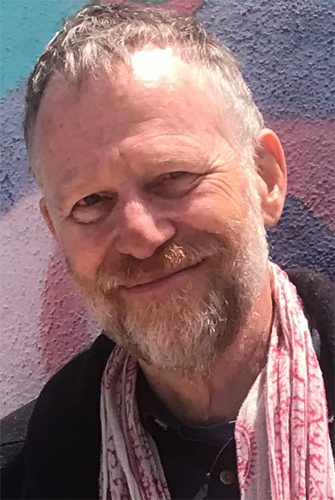
Award-winning author DEAN SLUYTER (pronounced “slighter”) has taught natural approaches to meditation and awakening since 1970. He gives talks, workshops, and retreats throughout the United States and beyond, from Ivy League colleges to maximum-security prisons. His media appearances have included National Public Radio, The New York Times, Coast to Coast AM, The Dr. Oz Show, and O, The Oprah Magazine.
A grateful student of Eastern and Western sages in several traditions, Dean has completed numerous pilgrimages and retreats in India, Tibet, Nepal, and the West. He is known for conveying authentic teachings in forms that are relaxed, accessible, and down-to-earth.
In addition to writing and teaching, Dean narrates audiobooks, co-hosts The Filmosophers movie podcast, sings with the Threshold Choir, and happily zips through the streets of Santa Monica on his Vespa.
Dean lived in New Jersey for thirty-three years, where he developed classroom meditation programs at The Pingry School and worked with inmates at Northern State Prison and Mountainview Youth Correctional Facility. He is now on the faculty of the West Coast Writers Conferences and is married to documentary filmmaker Yaffa Lerea.
https://deansluyter.com
My 10 Best
(In no particular order)
Mad Magazine
The first spiritual book that changed my life was not a book at all but the late, lamented humor magazine, Mad. At the height of the Cold War, Mad taught me and a whole generation of adolescent baby boomers to laugh in the face of scary realities like the hydrogen bomb and to see the fundamental, unconcealable human ridiculousness beneath the pomp of politicians and authority figures. But for me, Mad’s influence went even deeper. One afternoon when I was twelve years old, the image of the magazine’s happy simpleton mascot, Alfred E. Neuman, and his slogan, “What, Me Worry?” triggered my first full-blown samadhi experience. For real.
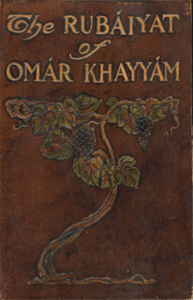
The Rubaiyat of Omar Khayyam
I discovered The Rubaiyat in my junior year of high school. As my buddies and I went about our drunken night rambles through the streets of the San Fernando Valley, I would recite aloud Omar’s verses on the glories of wine, the shortness of life, and the unreliability of everything but the fleeting moment. Sure, The Rubaiyat’s romanticized hedonistic element appealed more strongly to my hormone-maddened adolescent soul than it does to the mature me. But it was a lyrical introduction to the primacy of direct experience over orthodoxy and to the singular reality of the now.
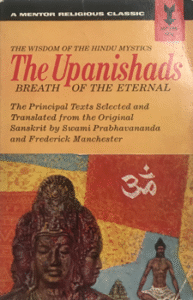
The Upanishads, Breath of the Eternal
This and the Bhagavad Gita, both in the slim Mentor paperback editions, were my first two books of Indian philosophy, which I somehow encountered and acquired in my last year of high school. As I read for the first time about atman, Brahman, karma, the cycle of rebirth, and the yogas that lead to liberation, something inside me said, “Yes, of course. Of course that’s the way things are, and of course that’s what life is for.”
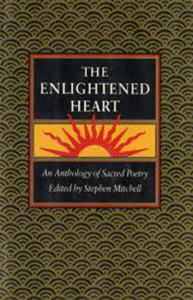
The Enlightened Heart
This is a superb collection of poetry both ancient and modern, Eastern and Western, familiar and obscure, all pointing us to open to the infinite. During my years teaching my Literature of Enlightenment course at a New Jersey prep school, this was an essential component of the syllabus. You can pretty much turn to any page at random and find yourself blown open. For the same reason, I still keep it close at hand. Mitchell, by the way, has also written one of the most invaluable books for understanding Christ and Christianity in the light of spiritual awakening: The Gospel According to Jesus.

Walden
After my first year of college, I dropped out and became a full-time hippie-sadhu with no visible means of support, hitchhiking and riding freight trains around the country, dropping in and out of communes and crash pads. (Hey, it was 1967.) The two books I carried in the little bag slung over my shoulder were the Tao Te Ching and Walden. The Tao Te Ching made the case for a life in tune with cosmic simplicity: “The way to do is to be.” Walden chronicled the possibility of actually living such a life. Thoreau, with his systematic elimination of all that is extraneous, was my model. Once, as I stood trying to thumb a ride somewhere in the Midwest, I realized that I had two pairs of shoes but only one pair of feet. I left the extra pair on the side of the road for the next guy.

Maharishi Mahesh Yogi’s Commentary on the Bhagavad Gita
After two and a half years of quasi-sadhu life, I was ready to get off the road. Again, it was an Eastern scripture that pointed the way — not just the Bhagavad Gita, but specifically Maharishi’s commentary on it. Like many seekers both Eastern and Western, I had interpreted the Gita as requiring a life of ascetic renunciation. But now Maharishi challenged that understanding as too superficial. The attachment that must be renounced is inner, not outer — a mental state and not just a lifestyle. After wrestling with this new idea like Jacob wrestling with the angel, I finally surrendered. I finished college, got a haircut, trained with Maharishi, and became a teacher of his method, Transcendental Meditation. Later on, I came to view his approach as, in some ways, too limiting and too simplistic, and I moved on. But the fundamental principles — that meditation must be natural and effortless to be effective, and that liberation can be lived in the context of a completely conventional life — have remained with me.

Miracle of Love: Stories About Neem Karoli Baba
Like so many others, I was deeply influenced by Ram Dass’s seminal book Be Here Now. I first encountered it in its earliest form, when its four sections were four separate little booklets that all came in a box. I also had a couple of memorable meetings with Ram Dass at pivotal points in my life, the first one at the Lama Foundation in New Mexico in 1969. For a writing project in the early 90s, I interviewed him about his guru, Maharaji Neem Karoli Baba. To prepare, I went to a bookstore and found Miracle of Love, RD’s collection of anecdotes and remembrances of Maharaji, gathered from numerous Indian and Western disciples after his passing. As I stood in the aisle of the bookstore, leafing through the book and reading one little story after another, I suddenly started to experience Maharaji’s darshan, his vivid spiritual presence beyond time and space, with lightningbolt clarity. Well, this was a surprise! For the next year or two, that became my spiritual practice. “Meditation” became simply resting in that darshan. In dreams, I met Maharaji and received subtle empowerments from him. And then, as abruptly as it came about, this phase ended and I moved on.
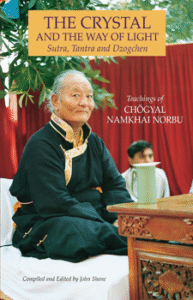
The Crystal and the Way of Light
This was one of the first books I read on the Varjrayana (Tibetan Buddhist) path. Namkhai Norbu Rinpoche belonged to the last generation of lamas to complete their spiritual education in Tibet, before he was forced into exile and wound up in Italy. The book combines a Vajrayana primer with Norbu Rinpoche’s sometimes astonishing tales of the old days. (When he entered the monastery at the age of ten, his first task was to build a coffin, which he would then sleep in every night. The Tibetans were hardcore!) I found a graceful beauty in the way he laid out the Vajrayana system, with everything in threes: the Triple Gem of Buddha, Dharma, Sangha; the practices of mind, breath, and body; etc. Ultimately, the most transformative Buddhist book for me turned out to be Lex Hixon’s translation of the Prajnaparamita Sutra, Mother of the Buddhas. Key line: “Enlightenment is nothing other than the spontaneous experience of all possible structures as equivalent to open space.”
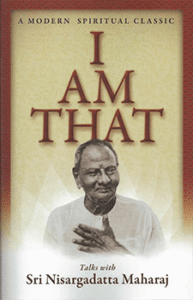
I am That
This classic of self-inquiry has been called “the last spiritual book you’ll ever read.” It’s a thick compilation of transcripts of the fiercely nondual dialogs between Nisargadatta, the enlightened cigarette merchant of Bombay, and the seekers who eventually came from all over the world to sit in the little room he built above his tenement apartment. There was nothing gentle about his approach. Like God’s hit man, he was there to kill your notion of yourself as a limited, separate self, and he was all business. He didn’t like people wasting his time — if he decided you were unserious, he threw you out of the room. Full disclosure: I’ve never gotten all the way through this book. I can’t read more than about a page and a half at a time before my skull starts exploding.

Presence Volume 1: The Art of Peace and Happiness
Among contemporary teachers, it’s hard to beat Rupert for laying out the What’s What of life so clearly that it seems inarguable, even self-evident. Again and again, he brings you back to your actual experience, cutting through your habitual assumptions. Do you actually experience time? Do you actually experience a separate self? Do you actually experience an outside world? Proceeding so systematically you sometimes feel as if you’re reading proofs in geometry, Rupert walks you step by step from where you thought you were to where you’ve really been all along. I’ve attended a number of his retreats, and his speaking style, like his writing style, strikes some people as a bit dry. (He’s aware of it; he jokes about it; he knows he’s British.) That’s fine with me. I’ve fallen in and out of love with enough flashy, charismatic teachers for this lifetime, thank you. As John Lennon said, “Just gimme some truth.”